The Art Of Doing Anything Exceptionally Well (A Samurai Guide to Mastery)

Source: Discipline Dojo
When was the last time you did anything — anything at all — to the absolute limit of what you were capable of?
Not 80%. Not good enough to move on. Not the version that would pass inspection. The complete, unhurried, fully inhabited version of the thing. The one where you did not stop where you usually stop. Where you stayed with the work past the point of comfort, past the point where anyone would have known if you stopped.
Most men hearing this question cannot honestly remember. Some have never done it once.
There is a specific kind of quiet shame that comes from this. Not the shame of failure — failure can be fixed. The shame I am describing is older and more dangerous. It is the shame of knowing you could be doing something better than you are. Not better than someone else. Better than yourself.
That gap between the man you could be and the man you actually are is the wound this book is about.
In the next pages, you are going to meet a master carpenter who spent 50 years closing it, and a young man named Daichi who walked into her workshop expecting to commission a piece of furniture and walked out three weeks later with seven principles that rearranged everything he thought he knew about what it actually means to do something well.
“The joint does not know it cannot be seen.” — Heinosuke, master carpenter, Himeji Castle, 1645
Chapter 1: The Invisible Joints of Himeji Castle

In 1645, an old carpenter named Heinosuke had spent 40 years working on the construction of Himeji Castle. He was not a samurai. He was not famous. He carved wooden joints that no one would ever see — interior structural connections sealed inside walls, hidden by other walls, invisible by design.
Later in his life, a younger man asked him why he made those invisible joints with the same care as the visible ones. The answer he gave became the foundation of the Japanese craftsman tradition for the next four centuries:
“The joint does not know it cannot be seen.”
Six words. The entire philosophy of mastery is inside those six words.
By the time we reach the end, you will understand exactly what they mean, why almost every man in the modern world has forgotten them, and what it costs you to keep forgetting them every day of your life.
The Story of Daichi
Daichi was 29 years old and had spent his entire life being pretty good at things. Decent at his job. Decent at his training. Decent in his relationships. He had never been bad at anything important. He had never been exceptional at anything either.
He was haunted not by his failures, but by the half-effort he had accepted as his default mode. He had been told his whole life that he had potential. He had spent his whole life confirming it — and never once turning that potential into anything that resembled mastery.
His grandmother had owned a small wooden box, hand-carved, plain. Nothing special to look at. But she had treasured it for 60 years and refused to be buried without it. When she died, Daichi opened it. Inside were three things and a small folded paper with a name and a village.
The name was Tomoe. The village was in the mountains, three days by train and then by foot. The note in his grandmother’s handwriting said only: “If you ever need to remember what good work is, go to her.”
Daichi did not need to remember what good work was. He needed to discover it.
He went the following month. The village was small enough that he found her without asking. Her house was at the edge, wooden, weathered, set back from the road behind a low stone wall and a garden gone slightly wild in the way that gardens go wild when a craftsman lives there and gives the wildness more attention than the order.
The workshop was attached to the house. Smoke from a small fire drifted from a vent in the roof. The sound of a chisel on wood came from the open door. He stood at the threshold and watched her work for several minutes before she acknowledged him.
She was small, maybe 78. White hair tied back simply. She wore work clothes that had been mended so many times the original fabric was barely visible. Her hands were the most precise things he had ever seen — older than the rest of her, knotted at the knuckles, but moving with the absolute economy of 50 years of repetition.
When she finally looked up, she did not greet him. “You are her grandson,” she said. It was not a question.
“How do you know?”
She returned to her work without answering. After a moment, without looking up, she said, “Come inside. Do not touch anything.”
He stayed three weeks.
He thought he had come to commission a piece of furniture. By the end of the first afternoon, he understood that he had come for something else entirely — something he could not name yet, and that Master Tomoe had no intention of explaining.
She did not teach. She simply worked. And in three weeks, he learned more from watching her work than he had learned in 29 years of being instructed.
This is what she showed him.
Chapter 2: Kuzushi — Break What You Think You Know
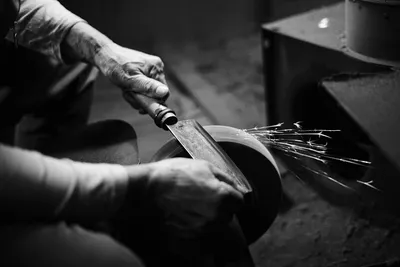
Mastery begins by breaking what you know.
On the second morning, Tomoe asked Daichi to help her select a piece of wood from the stack at the back of the workshop. He had grown up around carpentry. His father had been a hobbyist. He knew the basics. He chose a clean, straight-grained piece, clearly the highest quality in the stack, and presented it to her with the quiet confidence of a man who had been complimented his whole life for choosing well.
She looked at the piece for one second. “Put it back.”
He returned it to the stack, confused. “Choose again.” He chose a different piece, similar quality, slightly different grain pattern. “Put it back.” This continued for six selections. Each time he chose what looked to his trained eye like a good piece of wood. Each time she rejected it without explanation.
On the seventh selection, frustrated, he picked a piece that was visibly flawed — a knot near one end, slight warping in the grain. He presented it almost defiantly.
She nodded once. “This one.”
He could not understand why.
That evening, she finally spoke: “You know what good wood looks like. That is your problem. Every piece you selected was technically correct. None of it was right. You were choosing from a list. I was choosing for a purpose. Until you stop trusting what you already know, you cannot learn anything from me.”
The Breaking of Assumptions
This is Kuzushi — the breaking of assumptions.
The Japanese martial arts use the word to describe the moment when you destroy your opponent’s balance before the throw. In mastery, it describes something even more fundamental: the moment when you destroy your own balance, your own sense of competence, so that something more accurate can be built in its place.
Every man who has reached mastery in any field has crossed this threshold. The decision to admit that what you know is in the way of what you could know. That your competence is a ceiling, not a floor.
Most men spend their lives defending the competence they have built. The master spends the early years dismantling it. On the other side of that dismantling is the only ground on which real mastery can be built.
“Your competence is a ceiling, not a floor.”
Daichi went to sleep that night, humbled in a way that was not painful. It was clarifying. For the first time in years, he did not know something. And not knowing felt like the first honest place he had stood in a long time.
Chapter 3: Shokunin — The Joint Does Not Know It Cannot Be Seen
In the second week, Tomoe began work on a wooden chest for a family in the next town over. She spent two full days on a single joint — a complex interior connection that would never be visible once the chest was assembled.
She measured it 11 times. She tested the fit. She removed it. She refined it. She tested it again. She did this with the same intensity she would have brought to a surface visible to every visitor.
Daichi watched on the second afternoon and finally asked the question that had been forming since the morning: “No one will ever see that joint.”
She did not look up from her work. “The joint does not know it cannot be seen.”
He did not understand. She continued working.
“Every joint I cut is built into me, not into the chest. If I make a hidden joint poorly, I have not cheated the customer. I have cheated myself. I have taught myself that I am the kind of person who works one way when seen and another way when not seen. Once I have taught myself that, I am no longer a master. I am a performer.”
“The performance ends when the audience leaves. The master continues after they have all gone home.”
The Craftsman Spirit
This is Shokunin — the craftsman spirit. The principle that the quality of your work in the hidden places determines the quality of your work everywhere.
Most men work for an audience: their boss, their customers, their reviewers, the version of themselves they perform for in their own mirror. When the audience is watching, they produce careful work. When the audience is absent, they produce whatever is fastest.
This is the exact mechanism by which they remain mediocre forever.
Because the man you are when no one is checking is the man you are. The version that appears under observation is a performance. And no amount of performance is the same thing as having become a master.
“The man you are when no one is checking is the man you are.”
You cannot perform mastery into existence. You can only build it slowly in the hidden joints of your daily work, where the only person who will ever know how carefully you cut them is you.
Daichi watched her finish that joint over the course of the next two days, sealed inside the chest, invisible forever. He understood for the first time in his life why his own work had always felt like work, and her work felt like something else entirely.
Chapter 4: Kaizen — Sharpen the Chisel Every Morning for 50 Years

On the eighth morning, Daichi watched Tomoe sharpen her chisel for 30 minutes before she began work. He had assumed on previous days that she was simply preparing her tools, but this morning he paid attention.
The chisel did not need 30 minutes of sharpening. It had been sharp when she finished the previous day. The 30 minutes were not maintenance. They were practice.
She sharpened the chisel slowly with full attention, refining an edge that was already functional into an edge that was slightly better than yesterday’s edge.
She did not look up when she spoke: “This chisel has been sharpened every morning for 50 years. Not because it needed to be. Because I needed to be. The chisel is the proof. If I sharpen it well, I have shown up. If I sharpen it poorly, I have not. The chisel keeps the record more honestly than I would.”
The 1% Rule
This is Kaizen — the principle of continuous, small, almost invisible improvement applied daily for so long that the cumulative effect becomes something that looks from the outside like genius, and from the inside like consistency.
Modern self-improvement culture has tried to sell Kaizen as a productivity hack: the 1% better every day, the compound interest of small gains. This framing misses the point entirely.
Kaizen is not about results. The results are a side effect. Kaizen is about identity.
The small daily improvement is not what produces the master. The small daily improvement is what a master is. The improvement is the practice. The practice is the master.
The mediocre man waits for the big breakthrough, the big project that will demonstrate his capability, the major effort that will close the gap between who he is and who he could be. He is always waiting. He never arrives.
The master sharpens the chisel today, tomorrow, 50 years.
“The small daily improvement is what a master is.”
Daichi sat with this. He thought about every project he had started and abandoned in search of a more important one. Every skill practiced for two weeks and dropped. Every morning he had failed to do the small ordinary thing because it did not feel like enough.
He had been waiting for the big effort for 29 years. The big effort was a fantasy that allowed him to avoid the small daily one — which is the only thing that has ever produced mastery in any human being who has achieved it.
Chapter 5: Ma — The Space Between Effort Is the Effort

In the middle of the second week, Tomoe stopped working in the middle of an active joint. She set her chisel down. She walked to the window of the workshop. She sat on a low wooden bench and looked out at the garden for 10 full minutes.
She did not look at her phone because she did not have one. She did not look at any book. She did not appear to be thinking about anything in particular.
Daichi waited for her to return to the work. After 10 minutes, she stood, walked back to the bench, and continued with the joint exactly where she had stopped.
Later, he asked her what she had been doing. “Resting.”
“In the middle of a joint?”
She looked at him. “You think rest is what happens after work. Yes. That is why you are not yet a master. Rest is what happens inside work. The space between the effort is the effort. The pause between the strokes is what makes the next stroke possible. Without the pause, the work is continuous, and the mind never has time to receive what is in front of it.”
“You think you are being more productive by not pausing. You are being less. You are simply more tired.”
The Void That Gives Form
This is Ma — the space between things. The Japanese concept that emptiness gives form to fullness. In design, in music, in conversation, in mastery. The void is not the absence of substance. The void is what allows substance to have meaning.
Western productivity culture has taught men that rest is what happens after work. That you deplete yourself, then rest to refill the tank. This is incomplete. And the incompleteness is what produces the burnout. The same culture then sells solutions for.
The master rests inside the work. Small pauses between movements. The reason a master can work for 10 hours and emerge clear is not that she has more energy than you. It is that she has structured the 10 hours around the spaces between effort, not around the elimination of those spaces.
“The space between the effort is the effort.”
Daichi started paying attention to his own work after that conversation. To the way he rushed through tasks without pauses. To the way he treated stillness as a failure of productivity. To the way his entire approach to effort was based on the assumption that pause was the enemy of progress.
He had it exactly backwards. And so does almost everyone he knew.
Chapter 6: Mushin — When the Work Performs Itself
In the third week, Daichi noticed something he could not unsee. He had been watching Tomoe work for nearly two weeks. He had observed her techniques, her timing, her tools. But on a Thursday afternoon, watching her plane a long piece of cedar, he realized something that had been in front of him the entire time:
She was not thinking about what she was doing.
Her hands moved with absolute precision. Her attention was completely present in the work. But there was no observer running inside her evaluating each movement, calculating the next one, monitoring the quality of the output. The work was simply happening through her, as her, without the part of her mind that would normally be standing slightly outside the action checking it.
He had never worked that way at anything in his entire life.
When she finished the piece and looked up, she saw the recognition in his face. “You saw it?” she said.
“How do you do that?”
She thought before answering. “You cannot do mushin. Mushin is what happens when you finally stop doing. After enough years of practice, the part of you that monitors the work falls quiet. Not because you suppressed it. Because it ran out of things to do. Every movement was already trained. There was nothing left to supervise. The supervisor went home. The work continued without him.”
No Mind
This is Mushin — no mind. Not the absence of consciousness. The absence of the supervisor inside consciousness.
The state every elite performer in every field has described under different names: Flow. The zone. The operation that performs itself.
The reason mushin is rare is not that it is mysterious. It requires years of consistent practice in a single domain to the point where conscious supervision is no longer needed.
You cannot biohack your way into mushin. You cannot produce it by trying. You can only build the conditions in which it arrives: the slow, patient, repetitive practice of a craft over enough years that the conscious mind finally trusts the body to do what it has been trained to do.
“The supervisor went home. The work continued without him.”
The man who has never worked at anything long enough to enter mushin has never actually known what mastery feels like from the inside. He has only seen it from the outside in masters and assumed it was talent.
It is not talent. It is what happens when practice goes on for so long that there is nothing left to think about.
Chapter 7: Wabi-Sabi — The Knot Is the Proof of Life

In the third week, Tomoe completed the chest she had been working on. When she assembled the final piece, Daichi noticed something that he had been silently questioning for days.
There was a single visible knot in the wood on the front panel. A small, dark imperfection that any other carpenter would have cut around or hidden. She had left it.
“Why?” he asked finally.
She looked at the knot for a moment. “Because the tree had it. And the tree was honest. The knot is where a branch grew. It is the place where the wood lived. To cut it out would be to pretend the wood had not been a tree. The chest would be perfect. And perfection that pretends is worse than imperfection that is honest.”
Honest Imperfection
This is Wabi-sabi — the Japanese aesthetic principle that beauty lives in honest imperfection. The cracked teacup repaired with gold is more beautiful than the unbroken one. The wood remembers it was a tree, and a master honors that memory rather than erasing it.
Mastery is not perfection. This is the principle that most men never understand.
They believe that to do something exceptionally well means to do it flawlessly. So they pursue flawlessness. And in the pursuit of flawlessness, they remove every trace of themselves from the work. Every honest imperfection, every personal mark, every sign that a particular human being made this particular thing on this particular day.
What they produce is technically correct and entirely soulless.
The master leaves the knot in the wood. Not because the master is careless. Because the master understands that the knot is the proof of life. The asymmetry is the signature. The slight imperfection that no one else would tolerate is what makes the work irreplaceable.
“Perfection that pretends is worse than imperfection that is honest.”
Daichi looked at the chest again. The knot caught the afternoon light. It was the most beautiful part of the entire piece.
Chapter 8: Michi — The Way Is Walked, Not Arrived At
On the last morning of his stay, Daichi sat with Tomoe in the workshop one final time. He had brought a small carved piece of his own, something he had attempted in the evenings using scraps. It was poor. He knew it was poor. He showed it to her anyway.
She looked at it for a long moment. “This is the work of a man who is still hoping he is good enough.”
He did not respond.
“That is the worst kind of work. It is not bad work. Bad work can be fixed. This is work done by someone who has not yet decided to be exceptional. There is no fixing that with technique. You have to decide first.”
She set the piece down. “Mastery is not a destination. It is michi, the way. You do not arrive at it. You walk it. Every morning in private, whether anyone is watching or not, for the rest of your life.”
“You either decide to walk the way, or you decide to keep hoping you are good enough at the things you do not actually commit to.”
She looked at him directly. “Go home. Do one thing tomorrow with the attention I have brought to a single joint that no one will ever see. One thing. Then the next day, do one more. You will not see the results for years. That is not the point. The point is that you will be the kind of man who is walking the way. And the kind of man who walks the way is the only kind of man who ever masters anything.”
The Only Decision That Matters
Daichi went home the next morning. On his first day back, he sat at his desk and did one ordinary task with the full attention Master Tomoe had brought to a hidden joint inside a wooden chest.
It took longer. It was harder. No one noticed.
It was the first hour of work he had ever done as a man who had decided to be exceptional, rather than a man hoping he was good enough.
That is where it begins.
The Seven Principles: A Summary
| Principle | Meaning | The Practice |
|---|---|---|
| Kuzushi | Break what you think you know | Dismantle your competence to build something more accurate |
| Shokunin | The joint does not know it cannot be seen | Work with equal care in hidden places and visible ones |
| Kaizen | Sharpen the chisel every morning for 50 years | Small daily improvements that compound into mastery |
| Ma | The space between effort is the effort | Rest inside the work; the pause makes the next stroke possible |
| Mushin | Practice until the supervisor goes home | Train until conscious supervision is no longer needed |
| Wabi-sabi | The knot is the proof of life | Honor honest imperfection over soulless perfection |
| Michi | The way is walked, not arrived at | Decide to walk the path every morning, whether anyone watches or not |
The Carpenter’s Legacy
The carpenter Heinosuke died in 1648. The joints he carved inside the walls of Himeji Castle are still there. They have held the castle through fires, earthquakes, 400 years of weather and war.
No one has ever seen them. They have not failed.
The joint does not know it cannot be seen.
And you are the joint. Every hour you work, every effort you make, every choice no one is watching. You are building yourself.
You can build yourself like a man hoping he is good enough. Or you can build yourself like a master who has decided.
The materials are the same. The hours are the same. The only difference is which version of yourself you have decided to be when no one is checking.
“Mastery is not what you do when you are being evaluated. It is what you do when no one will ever know.”
Tomorrow morning, choose one ordinary task. Do it the way Tomoe carved a joint that no one would ever see.
That is where mastery begins. In the one ordinary task done as if it mattered when no one will ever know.
That decision is still available tomorrow morning. It has always been available. It is the only decision that has ever mattered.